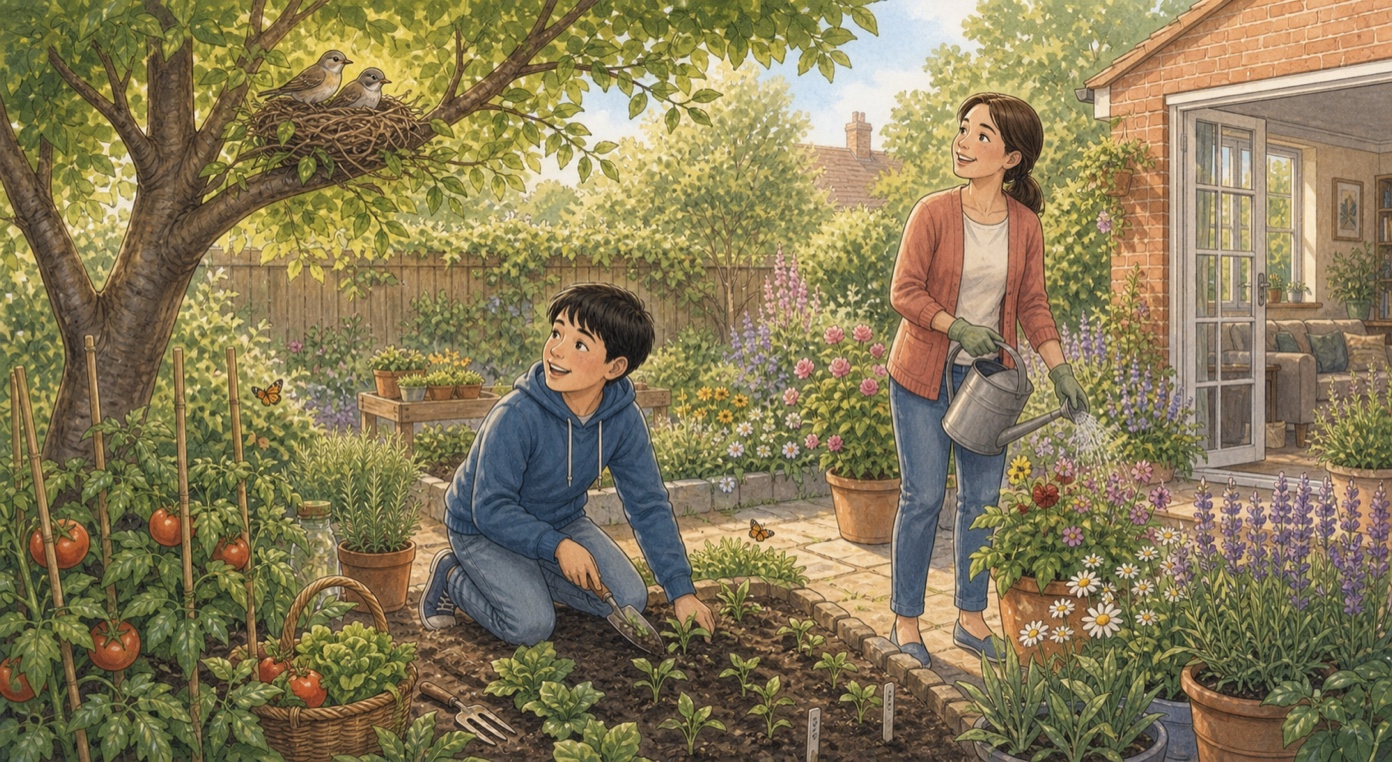
It was a warm Saturday in spring春天 /sprɪŋ/. Jack stepped outside户外 /ˌaʊtˈsaɪd/ into the back garden花园 /ˈɡɑːr.dən/ where Mum was already kneeling跪着 /ˈniː.lɪŋ/ by a flower bed花圃 /bed/. She had a pair of gloves手套 /ɡlʌvz/ on and a small pot花盆 /pɒt/ of soil土壤 /sɔɪl/ beside her. "What are you planting?" Jack asked. "Lavender薰衣草 /ˈlæv.ən.dər/," she said. "It's a beautiful plant植物 /plænt/ with a lovely scent气味 /sent/. Come and help me dig挖 /dɪɡ/ a little hole坑 /hoʊl/."
Jack grabbed a small trowel小铲子 /ˈtraʊ.əl/ and knelt beside her. The soil was dark and damp潮湿的 /dæmp/ — good for planting. Mum pointed to the lavender seedling幼苗 /ˈsiːd.lɪŋ/ with its tiny purple flower花朵 /ˈflaʊər/ just starting to bloom开花 /bluːm/. "See how the roots根 /ruːts/ wrap around each other? That means it's ready to go into the ground地面 /ɡraʊnd/." She lowered the plant in gently and pressed the soil around the roots. "Always make sure the roots have space to grow生长 /ɡroʊ/," she explained.
After planting, Jack took the watering浇水 /ˈwɔː.tər.ɪŋ/ can from the shed小屋 /ʃed/ and gave the new plants a gentle drink. "How much water水 /ˈwɔː.tər/ do they need?" he asked. "Not too much," said Mum. "Too much water can能(可能性) /kæn/ kill a plant just as fast as no water at all. " Jack nodded. "Like us at breakfast!" Mum laughed. "Exactly like that."
Next, Mum showed Jack how to pull up weeds杂草 /wiːdz/ — the unwanted plants that stole偷走(过去式) /stoʊl/ water and sunlight阳光 /ˈsʌn.laɪt/ from the good ones. "Get the whole root根 /ruːt/," she said. "If you only pull the stem茎 /stem/, the weed杂草 /wiːd/ will grow back quickly." Jack tugged使劲拔 /tʌɡd/ one out carefully, holding up the root with its clump一团;一簇 /klʌmp/ of soil. "Got it!" he said. "Well done," said Mum. "Put it in the compost堆肥 /ˈkɒm.pɒst/ bin垃圾桶;箱 /bɪn/ over there. It'll break分解 /breɪk/ down and turn into compost for next season季节 /ˈsiː.zən/."
They moved to the far end of the garden where there was a thick hedge树篱 /hedʒ/ and a wide lawn草坪 /lɔːn/. A tall tree树 /triː/ stood in the shade阴凉处 /ʃeɪd/ at the corner, its trunk树干 /trʌŋk/ wide and covered in bark树皮 /bɑːrk/. Long branches树枝 /ˈbrɑːntʃɪz/ spread伸展 /spred/ out above them, full of leaves树叶 /liːvz/. "What is this tree called?" Jack asked. "It's an oak橡树 /oʊk/," said Mum. "Very old and very strong强壮的 /strɒŋ/. Oak trees provide shelter庇护所 /ˈʃel.tər/ for many insects昆虫 /ˈɪn.sekts/ and animals动物 /ˈæn.ɪ.məlz/."
A butterfly蝴蝶 /ˈbʌt.ər.flaɪ/ landed on a bush灌木 /bʊʃ/ nearby, its wings opening and closing slowly. Jack watched it, delighted高兴的 /dɪˈlaɪ.tɪd/. "Look at that! What do butterflies eat?" "They drink nectar花蜜 /ˈnek.tər/ from flowers花 /ˈflaʊərz/," Mum said. "And bees蜜蜂 /biːz/ do the same. Bees are very important for the garden because they pollinate传粉 /ˈpɒl.ɪ.neɪt/ the plants. Without bees, many flowers would not bloom." A fat worm蚯蚓 /wɜːrm/ appeared in the soil near their feet. "Oh! A worm!" said Jack. "Good for the soil," Mum smiled. "Worms break it down and help plants grow."
They were about to head inside when Jack heard a soft rustling沙沙声 /ˈrʌs.lɪŋ/ above him. He looked up抬头看 and saw a small robin知更鸟 /ˈrɒb.ɪn/ on a low branch树枝 /brɑːntʃ/, carrying a piece of dry grass草 /ɡrɑːs/ in its beak鸟嘴 /biːk/. "It's building a nest巢 /nest/," Mum whispered低声说 /ˈwɪs.pərd/. They stood站着 /stʊd/ very still and watched看 /wɒtʃt/ until the bird flew飞走 /fluː/ off. "This garden is full of life生命 /laɪf/," Jack said. Mum smiled微笑 /smaɪld/. "That is why we look after it."